
How Creativity Shows up in AiC Work?
Creative practice in your therapeutic activities can simply look like:
Trying something new safely
Creativity offers a low-risk way to experiment without needing the “right” answer.
In therapy, this might look like a client gently testing a new way of expressing a feeling—using a color, a gesture, or a metaphor—before ever saying it out loud. The creative process becomes a rehearsal space, where new behaviors, emotions, or insights can be explored with support and choice.
In community settings, an artist might invite participants to contribute in multiple ways—observing, listening, making, or moving—so people can enter at their own pace. This flexibility reduces pressure and builds trust, allowing curiosity to replace fear.
Making the invisible visible
Creativity gives form to experiences that are often felt but hard to name.
In clinical work, a client might map their internal landscape—showing where stress, grief, or hope lives in the body—creating something both client and therapist can look at together. Once seen, these experiences can be reflected on, cared for, and transformed.
In sociocultural projects, artists help communities surface shared stories, values, or tensions through images, symbols, or collective gestures. What was once unspoken becomes visible and acknowledged, supporting understanding and collective meaning-making.
Shifting perspective
Creative processes invite people to see themselves and their experiences differently.
In therapy, a client might step into a different role through movement, writing, or role-play—momentarily experiencing an inner conflict from the outside. This distance often brings relief, insight, and new possibilities for response.
In community work, artists design participatory experiences that disrupt routine ways of seeing—inviting people to listen to unfamiliar voices or collaborate across difference. These moments can soften fixed narratives and open space for empathy and change.
Practicing agency
Creativity strengthens the capacity to choose, influence, and respond.
In creative arts therapy, clients make decisions constantly: what to engage with, how long to stay, when to pause, and what feels right. These small acts of choice build confidence and reinforce a sense of control—especially for those whose agency has been limited by trauma or circumstance.
In artist-led projects, participants shape the process itself—deciding how their voice is included, what feels meaningful, and how the work evolves. The act of contributing becomes an experience of being heard and having impact.
Building connection and belonging—with self and others
Creativity creates shared language where words alone may fail.
In therapy, creative practices help clients reconnect with internal cues—sensations, emotions, memories—strengthening self-awareness and self-trust. Over time, this internal connection supports clearer communication with others.
In community spaces, collective making, movement, or storytelling fosters connection across age, culture, and experience. Creating alongside others builds relationship, belonging, and a felt sense of being part of something larger.
Creativity in Therapy: Measurable Outcomes
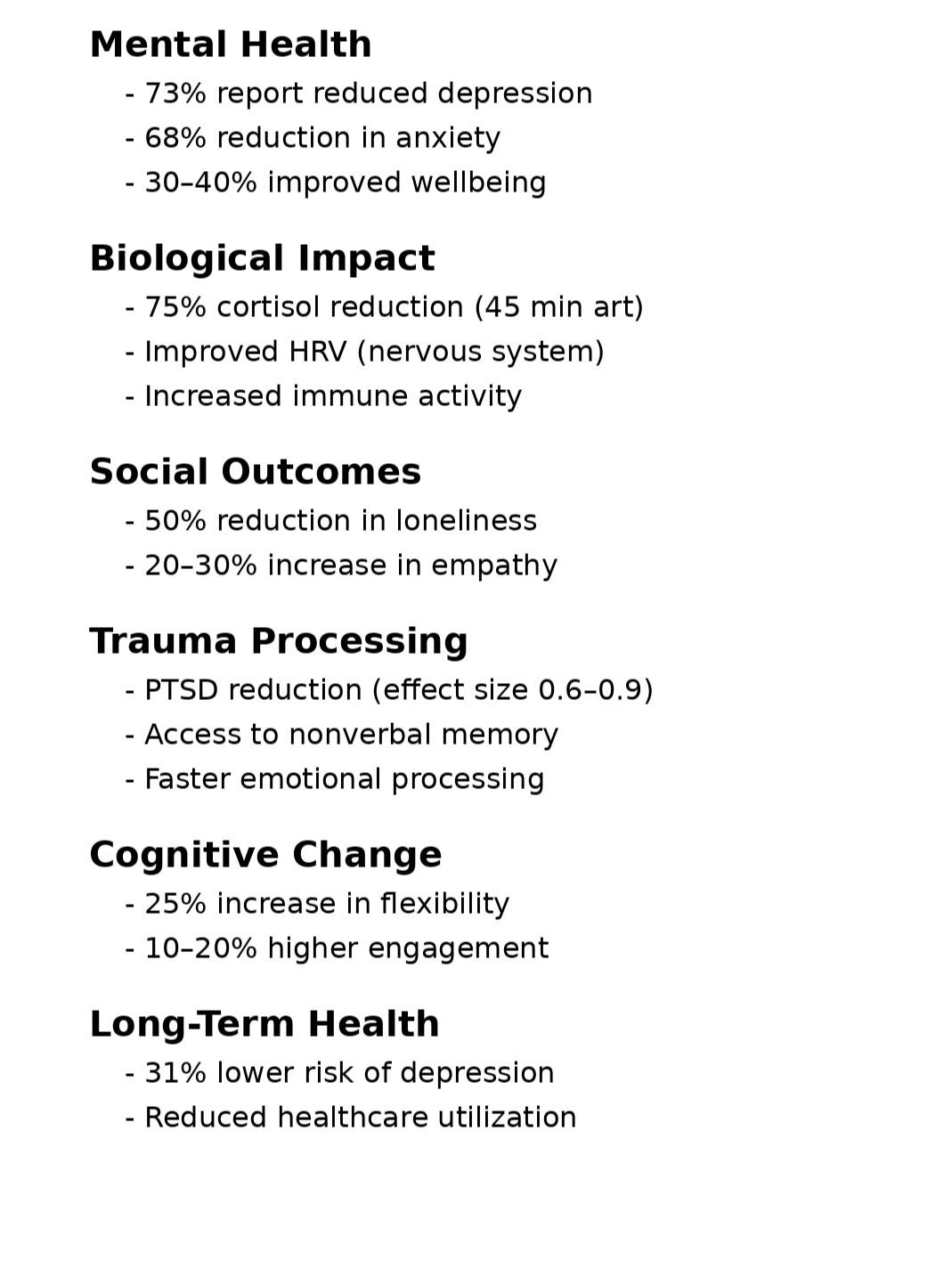

Benefits of Creative Arts Therapies
-
All of our senses are engaged in art-based processes. AiC providers engage clients’ nervous systems therapeutically during the creation process.
-
Support relational healing through shared, attuned enactment and witnessing
-
by trying new roles or responses in a safe, contained environment
-
Focus on the ‘here and now’ to reduce anxiety and fear and instead foster insight, spontaneity, and resourcefulness
-
Highlight problems with more immediacy: Seeing is believing - dynamics can be transformed more quickly when you’re enacting versus just describing.
-
Rediscover authentic ways of being and relating through creative spontaneity.
-
Relationships strengthen more successfully when we compassionately and supportively bear witness to each other's vulnerability in real-time.
-
Move past talk therapy limitations: Action methods are central, not just adjuncts, to healing because often times we don’t have words to describe what we’re sorting. We also can’t often work distress out of our bodies in a lasting way without some type of physicalizing action.
-
Your therapist or provider at AiC creates/moves/improvises with you in a meaningfully reflective and shared way. Both of you are experiencing spontaneity, increasing opportunity for real-time relationship practice.
-
Research shows that novelty, spontaneity, and play can interrupt anxious rumination by engaging the prefrontal cortex and default mode network, allowing new associations to form (Keng et al., 2011; Vrticka et al., 2013). Improvisation, by design, invites us to stay in the moment, respond with flexibility, and accept uncertainty—all antidotes to anxiety.
-
Movement and embodied expression deepen insight and change. Dance/movement therapy, drama therapy, and other embodied arts therapies activate non-verbal channels of awareness, which are often more accurate and emotionally rich than words alone (Pierce, 2014). These methods also support nervous system regulation, especially for those whose anxiety shows up physically.
-
Creativity improves emotion regulation and resilience. Engaging in creative activities has been linked to lower cortisol levels and enhanced problem-solving under stress (Kaimal et al., 2016). In couples and group settings, improvisational exercises like role-play and storytelling improve emotional attunement, empathy, and perspective-taking (Wiener & Oxford, 2003). In conflict, creativity gives us room to rehearse new roles, rewrite narratives, and practice repair—safely and with support.
“But I’m Not Creative”: Addressing the Myth

Great news; You’re off the hook! CREATIVITY IS AN INNATE HUMAN RESOURCE. We’re all born with imaginations and creative adaptability. Unfortunately, stress, anxiety, depression, etc. can dull our capacity to use it effectively. Creative arts therapies can help you reclaim it.
Mental health runs on creativity. Or in other words, mental health depends on your brain’s creative systems—the parts that help you notice patterns, imagine options, and try new responses. When those systems are active, you regulate emotions better, solve problems, and connect with people more easily.
Arts in Counseling applies the definition of creativity rooted in ancient traditions like Ma’at, Rta, and Tao - balancing life for yourself, relationships, and community. We do not define “being creative” as being artistic, talented or expressive.
How it shows up in real life
Reframing a worry so it feels workable
Finding a calmer way to respond in an argument
Turning a child’s meltdown into a game that resets the moment
Using humor or movement to de-escalate stress
What it means for care at Arts in Counseling
We practice creativity (imagination, play, movement, art, role-play) in session to build flexible, regulated, connected responses you can use outside session.
Using creativity is skill-building—It’s about spotting patterns, adapting and improvising amid uncertainty through exploring, taking risks, and connecting with the ultimate goal of restoring personal and communal balance.